- The Fitness First Report
- Posts
- The window closes Memorial Day
The window closes Memorial Day
Why the next ten weeks matter more than you think

Joshua Grenell
March 14, 2026
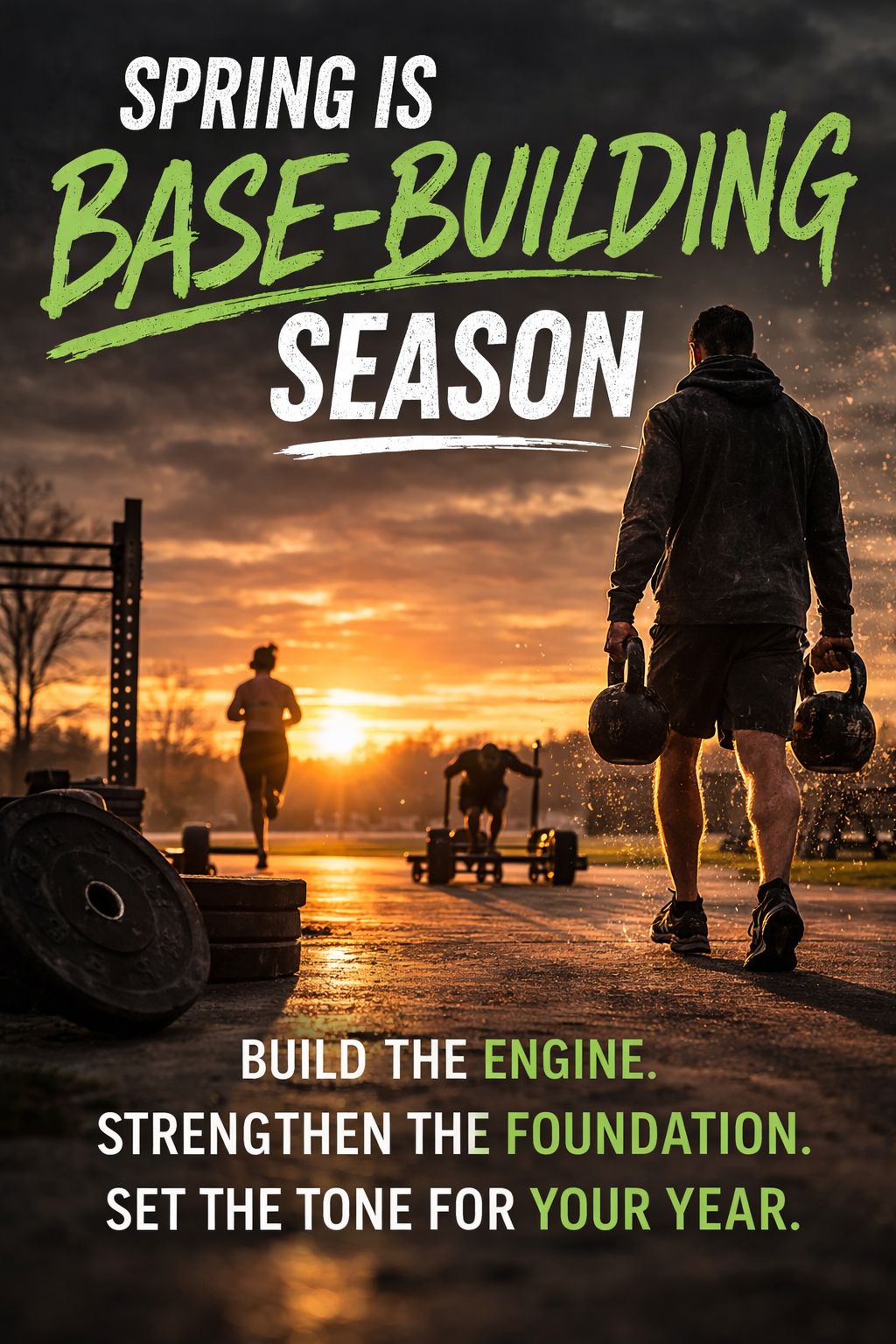
Spring Is Base-Building Season
Despite the incoming snowmageddon, something shifts in March. The days get longer, the air loses its bite, and for the first time in months, you feel like training again, not just grinding through it. That feeling is worth paying attention to, because it is one of the most useful biological signals your body sends. Lean into it wisely, and the next ten weeks can set the tone for your entire year. Waste it chasing intensity too soon, and you will arrive at summer fitter on paper but broken in ways that take months to diagnose.
The window between now and Memorial Day is base-building season. That framing is not an excuse to train easy. It is a reminder that the most productive thing you can do right now is invest in the physical qualities that make everything else possible: aerobic capacity and foundational strength. These are not glamorous adaptations. They do not show up in a highlight reel. But they are the difference between an athlete who holds up over time and one who cycles endlessly between hot starts and setbacks.
Why Base Matters More Than You Think
Winter does predictable things to people. Some overtrain, Others go dormant, reducing training volume until motivation returns. Both patterns leave the same gap: an underdeveloped aerobic engine and a movement foundation that has drifted toward whatever felt comfortable in the cold.
Aerobic base, what exercise physiologists call Zone 2 capacity, is the infrastructure beneath everything. It governs recovery between hard efforts, supports fat metabolism, regulates the nervous system, and determines how quickly you adapt to increased workload. When it is underdeveloped, intensity becomes a liability. High-effort sessions damage tissue faster than you can repair it, and the gains that should accumulate simply do not stick. Building aerobic base is slow, deliberate work, which is exactly why most people skip it. It is also why the people who do not skip it keep improving long after everyone else has plateaued.
Foundational strength works the same way. Not strength as in maximum lifts, though that matters, but the kind of structural integrity that comes from training the patterns your body was built around. Squat, press, pull, and carry. These four movement categories cover more functional ground than any other combination in training. They build the hips, the posterior chain, the shoulder girdle, and the grip that protect you in sport, in aging, and in whatever hard thing you decide to do next. When these patterns are trained consistently and loaded progressively, your body becomes more resilient. When they are neglected, everything downstream, speed, power, and endurance, sits on an unstable base.
Pick a Target Before You Pick a Program
Before you commit to any spring training block, you need an honest answer to one question: what are you actually preparing for? The answer shapes everything. If you are eyeing Murph on Memorial Day, your aerobic base work needs to be matched with pull-up and pressing capacity, and your running should build incrementally rather than appearing suddenly in week eight. If a spring marathon is on your calendar, Zone 2 running volume is the priority, and strength training becomes the support structure. If a bench press personal record is the goal, or a 5K you want to finally run well, the specifics change, but the principle stays the same. Your training should be organized around an outcome, not assembled from whatever seems interesting week to week.
Picking a target also gives you a built-in accountability structure, which is where the Test → Train → Retest model becomes practical rather than theoretical. Before you begin your spring block, establish honest baselines. Run a mile and note the time. Test a max set of pull-ups or ring rows. Track your squat and press numbers. Do a twenty-minute Zone 2 session and note how hard it feels. These numbers are not judgments; they are starting points. Write them down, train consistently for eight to ten weeks with your target in mind, and then retest the same markers. The gap between where you started and where you land is the clearest measure of whether your training was actually working or just keeping you busy.
What Base Building Actually Looks Like
For most people, a spring base-building block looks something like this. Two to three days per week of strength training built around the four foundational patterns: a squat variation, a press variation, a pull variation, and a loaded carry. The loading should be moderate to heavy, the rep ranges in the four-to-eight range for the main work, and the sessions should not leave you so wrecked that recovery bleeds into the next three days. Two to three sessions per week of Zone 2 cardio, running, cycling, rowing, or any sustained aerobic effort where you can hold a conversation and your heart rate stays in the range of sixty-four to seventy-two percent of maximum. These sessions feel almost too easy, which is how you know they are working.
What this structure does over eight to ten weeks is quiet but significant. Your aerobic system becomes more efficient at low intensities and more resilient at high ones. Your movement patterns sharpen. Your connective tissue adapts to load. And by the time summer arrives with its events, its outdoor demands, and its social pressures to do hard things, you are not scrambling to get ready. You are already there.
The Long Game Starts Now
There is a version of fitness that is always preparing and never arriving, forever in the getting-ready phase, forever delayed by the next injury or the next restart. Base building, done right, is the antidote to that pattern. It is not exciting. It will not trend. But it is the kind of training that compounds across years rather than cycles through seasons, and it is the foundation on which every meaningful fitness goal eventually depends.
Spring is short. Use it.
See you in the gym!
—JG
Reply