- The Fitness First Report
- Posts
- The Most Expensive Thing in Fitness Is a Conclusion You Drew Years Ago
The Most Expensive Thing in Fitness Is a Conclusion You Drew Years Ago
Update the story. Then test it

Joshua Grenell
March 21, 2026
The Story Is Outdated. The Evidence Isn't.
Most people aren't held back by a lack of motivation. They're held back by a conclusion they drew years ago.
Someone tells you they already know that doesn't work for them. Or they say they're too old to start something new. Or they've tried this before, and it never sticks. They're not being dramatic. They're not making excuses, at least not in the way that word usually gets used. They're being rational about a version of reality that existed years ago. The problem isn't the conclusion they drew. The problem is that they never went back to update it.
The brain is efficient. When you attempt something, and it fails, a program you couldn't sustain, a routine that fell apart during a brutal stretch of work, a return-to-fitness attempt that ended in an injury, the brain logs the outcome and writes a rule. That rule gets applied going forward, quietly and automatically, without requiring your conscious input. This is not a weakness. It is exactly how cognition is supposed to work. The brain is a pattern-recognition machine, and one of the patterns it is very good at recognizing is: the last time this went badly. So this time, don't try.
The problem isn't how the story formed. It's that it doesn't come with an expiration date.
Research has established something useful and slightly uncomfortable about this: it takes more compelling evidence to change a belief than it took to create one. Once a conclusion is in place, the brain actively filters for confirmation and routes around contradiction. The person who couldn't stay consistent ten years ago doesn't re-examine that verdict today; they quietly confirm it every time they see a hard workout on their feed or hear a coach promising transformation in eight weeks. The story doesn't feel like a story. It feels like a fact about themselves, drawn from experience, tested against reality. Which is precisely why it sticks. The issue isn't motivation or willpower. It's that people are operating with an outdated map of terrain that has genuinely shifted.
Three things in particular tend to change while the story stays the same.
The first is life itself. The context that made consistency impossible may no longer exist in the same form. The version of you that failed at building a training habit was operating under a specific set of conditions: a commute that consumed two hours a day, young kids who didn't sleep, a job that extracted everything you had by Thursday afternoon, and a schedule that left no legitimate margin. Those conditions are not permanent. People change jobs, kids grow up, and routines restructure in ways that open up time and energy that weren't there before. The "me" that couldn't sustain a training habit was doing the best it could with what it had at the time. That version of you isn't the current version. But if you never revisit the story, you carry the verdict forward anyway, into a life where the original conditions no longer apply.
The second is science. The "too old" belief deserves particular attention because it is one of the most thoroughly dismantled pieces of conventional wisdom in human performance research. For decades, the working assumption was that the brain's capacity for adaptation peaked in young adulthood and declined from there, that the window for building new physical competence narrowed progressively with age, until it was more or less closed. That assumption has not held up to scrutiny. Imaging technology developed over the last decade has shown that the brain retains meaningful plasticity well into older age, the capacity to form new neural connections, to acquire new motor skills, and to adapt to new physical demands. This is not motivational language. It is what the data shows. Researchers now describe a "neuroplasticity of aging" in which people who remain physically active continue to see meaningful neural adaptation regardless of chronological age. One large longitudinal study found that older adults with a positive self-perception of aging lived an average of 7.5 years longer than those with a negative self-perception. That is not a footnote. That is a measurable biological consequence of the story you tell yourself about what's possible for you going forward.
The third is the tools available. The program you struggled through in 2013 or 2016 is not the same category of thing being offered now. A decade ago, personalized training meant a coach who spent five minutes adjusting a generic template to fit your schedule. What exists in good gyms right now is programming that adapts in real time to your recovery, your stress load, and your actual physiological response to volume and intensity, and that is structurally different from what came before.
The barriers that made your last serious attempt collapse may simply be gone. Access to quality coaching used to require proximity and a significant financial commitment. That gate has moved substantially. The approach that didn't fit you the last time around wasn't a verdict on your trainability. It was a verdict on that approach, in that context, with the tools that existed then.
The harder question, then, is not whether the old story was accurate when it was written. It probably was. You tried something, it didn't work, and you drew a reasonable conclusion from available evidence. That is not failure. That is how a functioning mind processes experience. The harder question is whether you've updated the story since, and most people haven't. Not because they're irrational, but because genuine belief revision requires actively seeking out evidence that contradicts what you already believe, and the brain resists that work with considerable force. It is much easier and less uncomfortable to let the old conclusion stand.
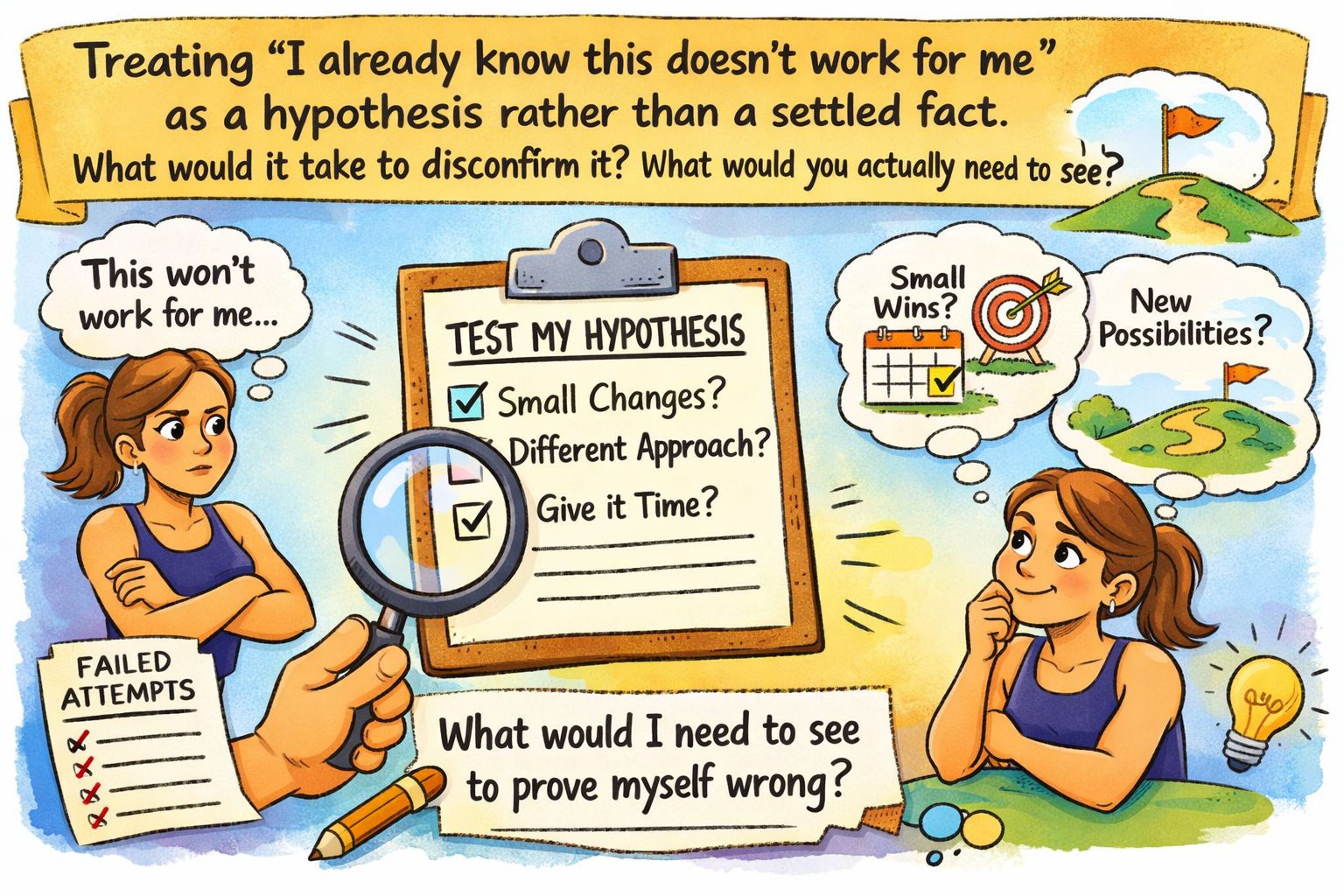
The practical reframe isn't "you can do it," which is motivational, cheap, and accomplishes nothing. It's treating "I already know this doesn't work for me" as a hypothesis rather than a settled fact. What would it take to disconfirm it? What would you actually need to see? That question is worth sitting with, because the answer is usually smaller and more available than the story has made it seem.
The people who show up consistently over the long term aren't the ones who finally found the perfect protocol or unlocked some interior reserve of motivation they didn't previously have. They're the ones who stopped letting an old story make current decisions. The goal isn't to prove the story wrong. It's to recognize that it was written by a different person, in a different season, with different tools available, and different constraints in place. That person did the best they could with what they had.
The current version of you has more to work with. Update the story. Then test it.
Let's start testing!
See you in the gym.
—JG
Reply